



Why Leather Wallet Quality Is So Often Misjudged
Leather is one of the most misunderstood materials in consumer goods. Unlike metals or plastics, leather is organic, variable, and responsive to the environment and use. Two wallets made from leather can behave entirely differently depending on the hide quality, tanning method, finishing, and construction.
Several factors make leather wallet quality difficult to assess:
- Marketing language is inconsistent and often misleading
- Visual uniformity is mistaken for quality
- Early softness is confused with durability
- Price is assumed to reflect material quality
In reality, a wallet’s long-term quality is determined less by how it looks on day one and more by how it responds to daily stress over time.
What “High-Quality Leather” Really Means
High-quality leather is often described using vague terms like “premium,” “luxury,” or “authentic,” but none of these labels reliably explain how a leather wallet will perform over time. In practical terms, high-quality leather is defined by structure, consistency, and behaviour under use, not by how impressive it sounds on a product page.
At its core, high-quality leather starts with the upper layers of the hide, where collagen fibres are densest and most interwoven. These fibres give leather its strength, resistance to tearing, and ability to age without breaking down. Leather taken from lower layers may still be technically real leather, but it lacks the fibre density required for long-term durability in a wallet.
Quality is also reflected in how the leather has been processed and finished. High-quality leather is tanned and finished in a way that preserves fibre integrity rather than masking imperfections. This means minimal sanding, limited use of heavy surface coatings, and finishes that allow the leather to breathe and respond naturally to handling. When leather is heavily corrected or sealed to achieve a uniform look, it may appear refined initially, but it loses its ability to age well.
Another defining feature of high-quality leather is predictable ageing. Rather than peeling, cracking, or flaking as it wears, good leather changes gradually. Colour deepens, the grain smooths, and marks blend into the surface. These changes indicate that the leather is responding at a fibre level rather than simply losing a surface layer.
High-quality leather also maintains functional performance over time. In a wallet, this means folds remain flexible rather than brittle, card slots retain strength, and edges do not fray or delaminate. The leather may soften, but it does not lose cohesion or structural stability.
Finally, quality leather aligns with purpose. A high-quality leather wallet does not need to look flawless forever. Instead, it needs to perform reliably, feel better with use, and develop character without compromising durability. When leather meets these criteria, its quality becomes evident not at the moment of purchase, but over the years of everyday use.
Step One: Understanding Leather Grades (And Their Limits)
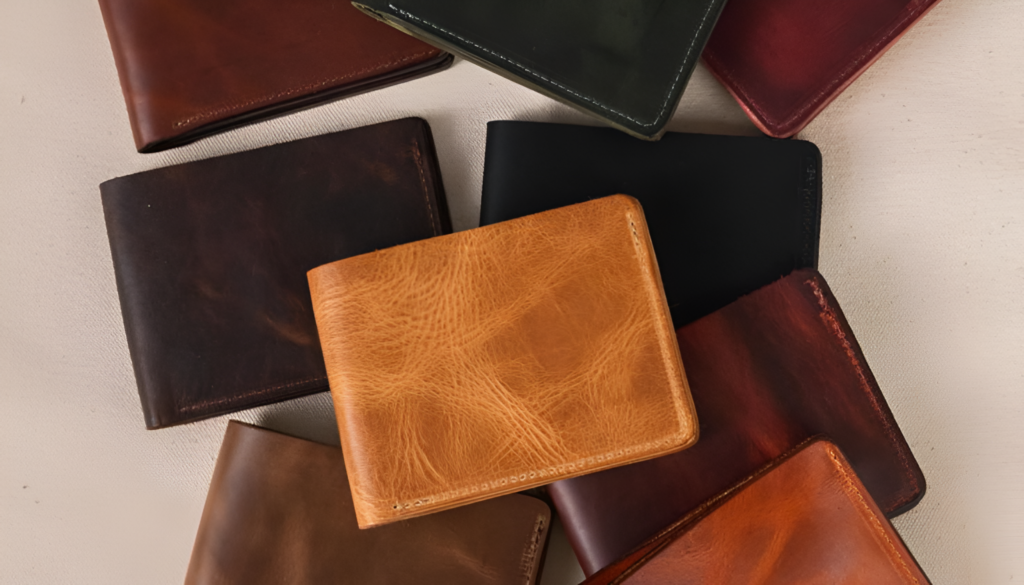
Leather is commonly grouped into categories such as full-grain, top-grain, and genuine leather. These terms can be useful, but they are often oversimplified or misused.
Full-Grain Leather
Full-grain leather retains the complete outer layer of the hide. This layer contains the densest and strongest fibres, which is why full-grain leather is widely regarded as the best starting point for durable wallets.
A full-grain wallet typically:
- Shows natural grain variation
- Develops patina over time
- Resists tearing and stretching
However, not all full-grain leather is equal. Poor-quality hides can still be full-grain but lack density or consistency.
Top-Grain Leather
Top-grain leather is sanded or corrected to remove surface imperfections, then finished for uniformity. It often feels soft and looks refined, but the correction process reduces ageing potential.
Top-grain wallets may:
- Look consistent initially
- Resist patina development
- Show wear through surface breakdown rather than character
Genuine Leather
Despite the name, “genuine leather” typically refers to the lower layers of the hide, combined with additional finishes. These leathers often lack the fibre density required for long-term wallet use.
Genuine leather wallets tend to:
- Age poorly
- Crack or peel at stress points
- Lose structure quickly
Understanding these categories is helpful, but they are only a starting point.
Step Two: Examining the Leather Grain
The wallet’s leather grain reveals more about quality than almost any label.
Natural vs Corrected Grain
High-quality leather typically exhibits natural variation in its grain pattern. This includes slight inconsistencies, pores, and subtle texture changes across the surface.
Corrected leather, by contrast, often looks:
- Extremely smooth
- Uniform across all panels
- Slightly artificial or flat
Uniformity is often a sign that the surface has been sanded and coated.
Grain Depth and Texture
Run your fingers lightly across the leather:
- High-quality leather has depth and texture
- Low-quality leather feels flat or plasticky
Press gently and release. Good leather will show slight movement and then recover, rather than remaining indented.
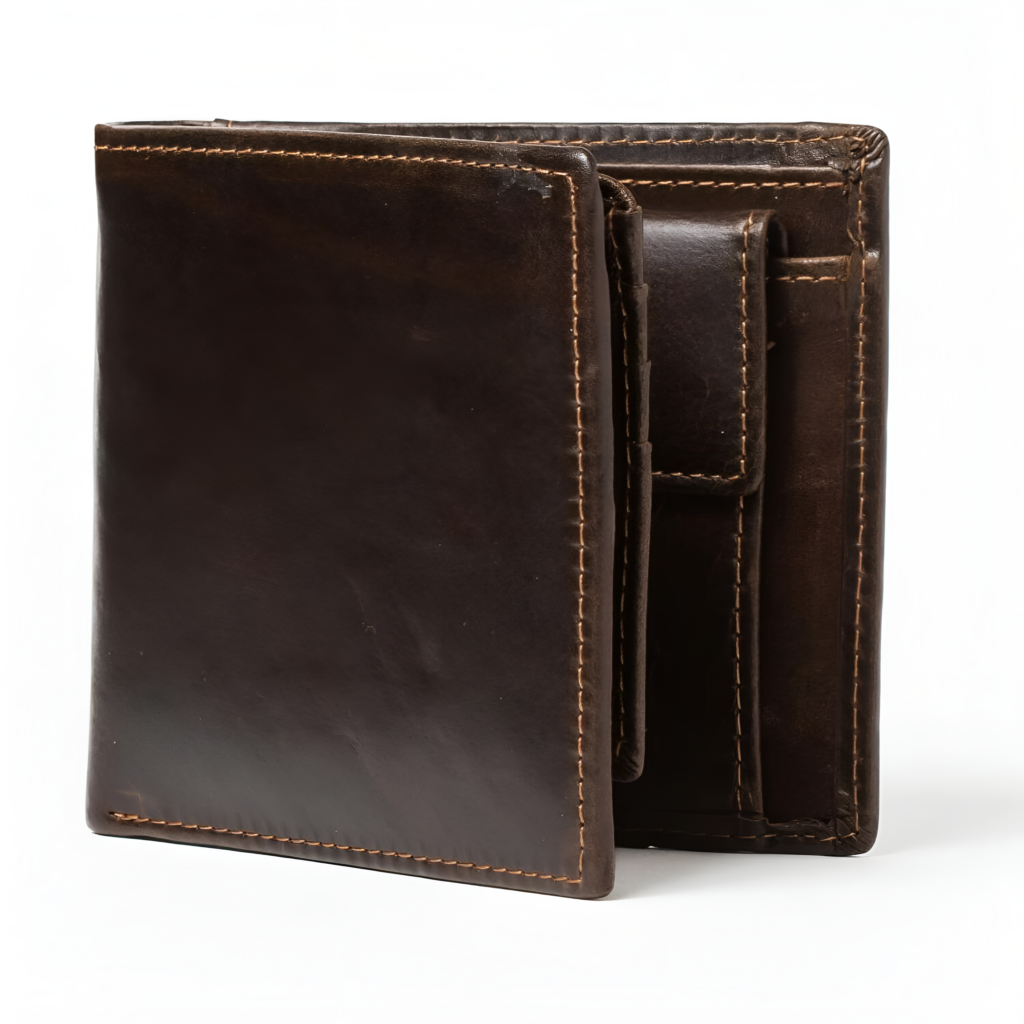
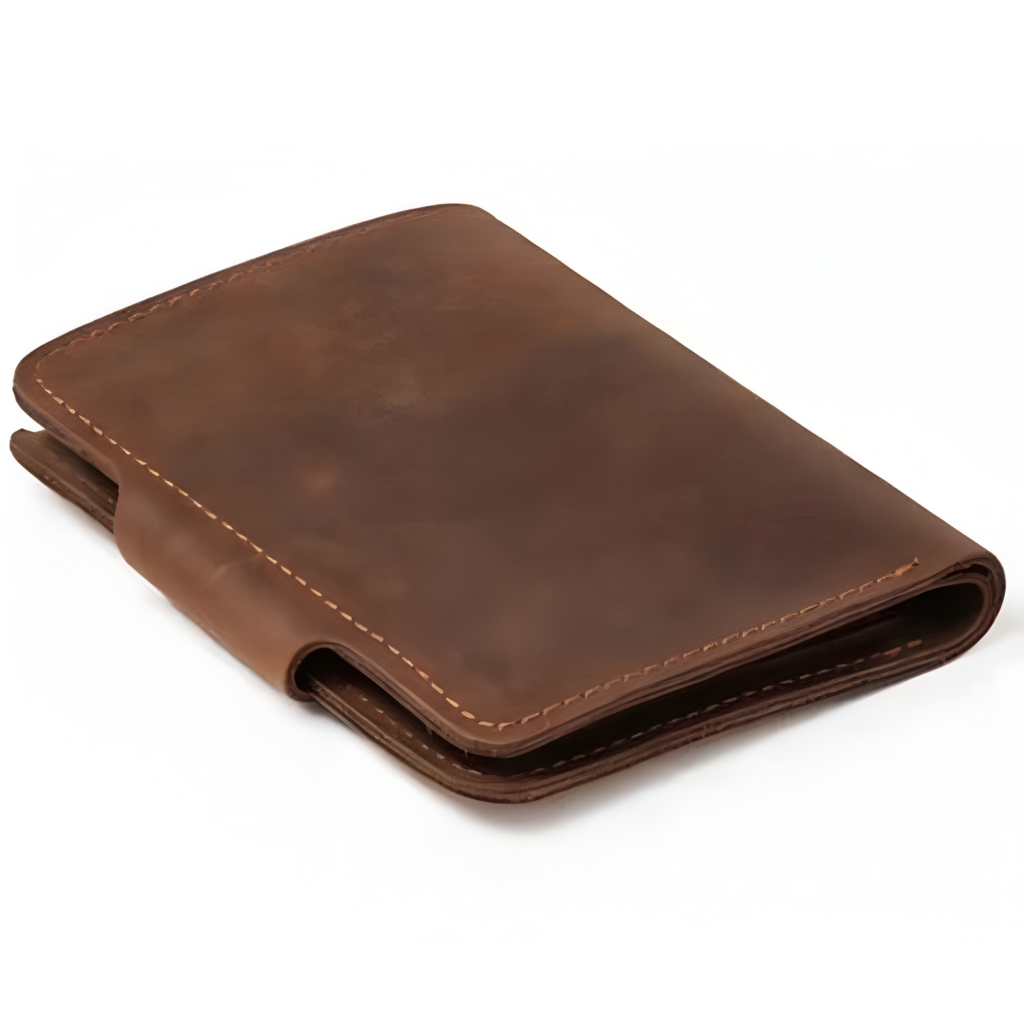
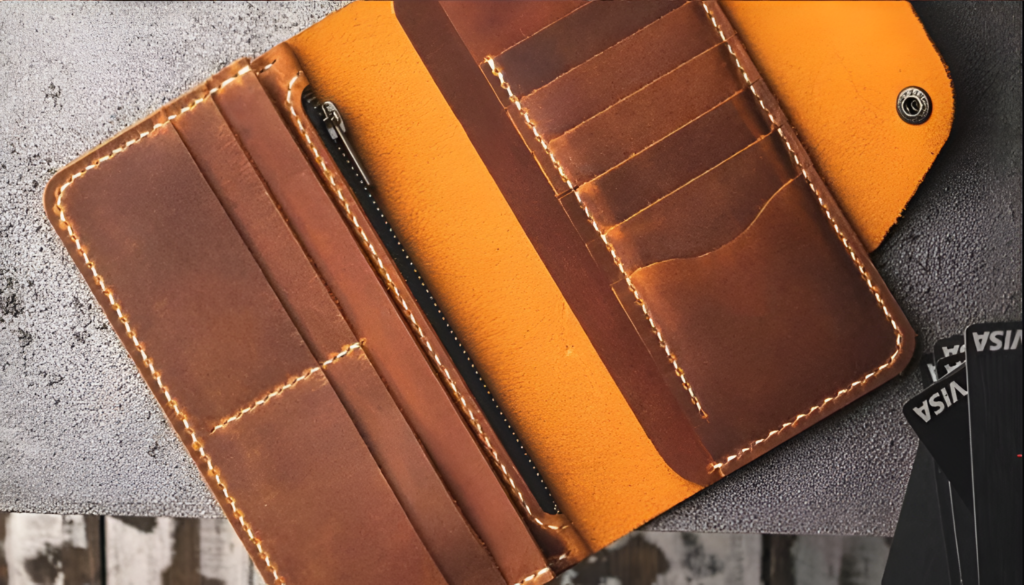
Flexibility is a key indicator of quality in wallets.
Bend the wallet gently:
- High-quality leather bends smoothly
- The fold feels rounded, not sharp
- The leather does not crack or suddenly resist
Release the bend:
- Good leather recovers gradually
- Poor leather may retain sharp creases immediately
Leather that fights movement or creases sharply is more likely to crack over time.
Step Four: Smell An Underestimated Indicator
The smell of leather is not definitive, but it can be revealing.
High-quality leather often has:
- A warm, natural leather scent
- Subtle, organic notes
Lower-quality leather may smell:
- Chemical or plastic-like
- Overly perfumed to mask processing
Smell alone should not determine quality, but it can support other observations.
Step Five: Surface Finishing and Coatings
Surface finish plays a major role in how a wallet ages.
Signs of Heavy Coating
- Glossy or plastic-like sheen
- Perfectly uniform colour
- Lack of grain texture
Heavily coated leather may resist marks initially, but when wear appears, it often looks like damage rather than patina.
Signs of Light or Natural Finishing
- Matte or softly reflective surface
- Visible grain
- Colour variation
Lightly finished leather allows the wallet to age naturally.
Step Six: Stitching Quality Matters More Than Many Realise
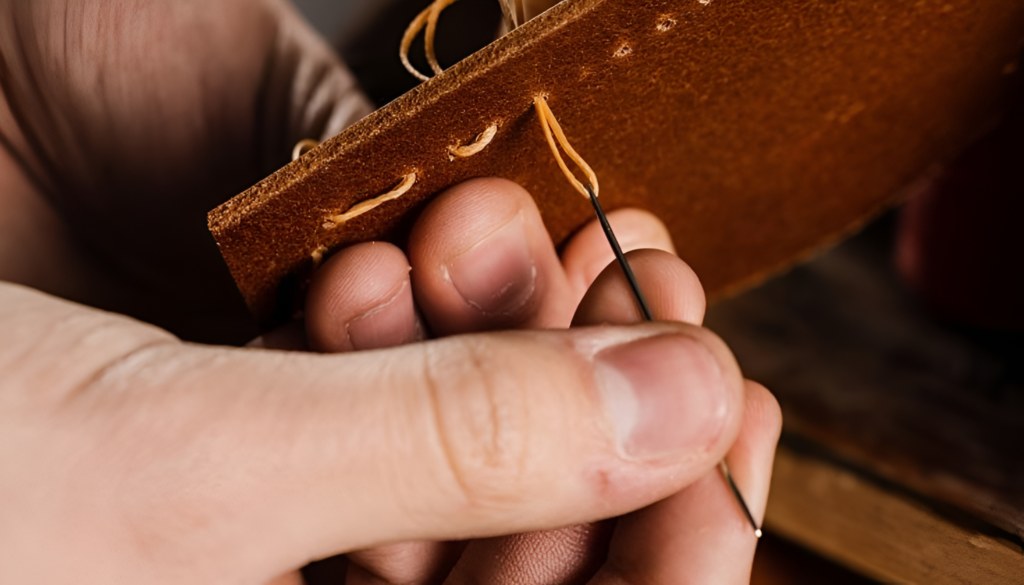
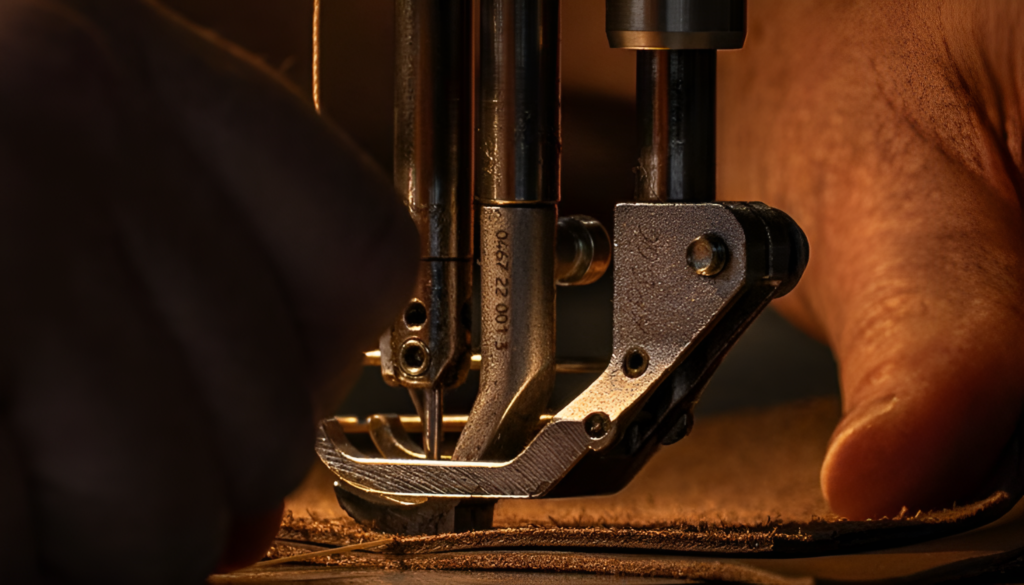
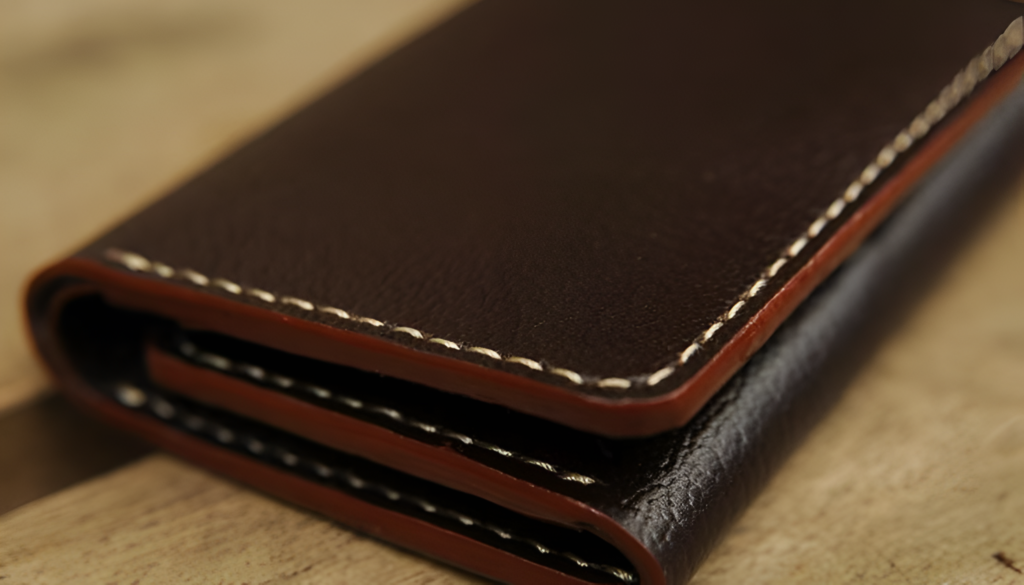
Leather wallet stitching is not just decorative. It plays a critical role in durability.
Stitch Density and Consistency
High-quality wallets typically have:
- Even stitch spacing
- Tight, consistent tension
- No loose threads
Uneven stitches indicate rushed or poor craftsmanship.
Thread Type
Stronger wallets often use:
- Waxed polyester or nylon thread
- Saddle stitching rather than machine lockstitch
Saddle stitching ensures that if one stitch breaks, the seam does not unravel.
Step Seven: Edge Finishing
Edges reveal whether a wallet was made to last.
High-Quality Edge Treatment
- Burnished edges that are smooth and sealed
- Edges that feel rounded, not sharp
- Consistent finish along all panels
Low-Quality Edge Treatment
- Raw, fuzzy edges
- Thick edge paint that cracks
- Uneven coating
Edges are high-wear areas. Poor finishing here shortens lifespan.
Step Eight: Construction and Layering
A high-quality leather wallet is not made from leather alone. Construction choices matter.
Panel Alignment
Look for:
- Even alignment between layers
- Clean corners
- No puckering or warping
Internal Reinforcement
Quality wallets often include:
- Reinforced fold areas
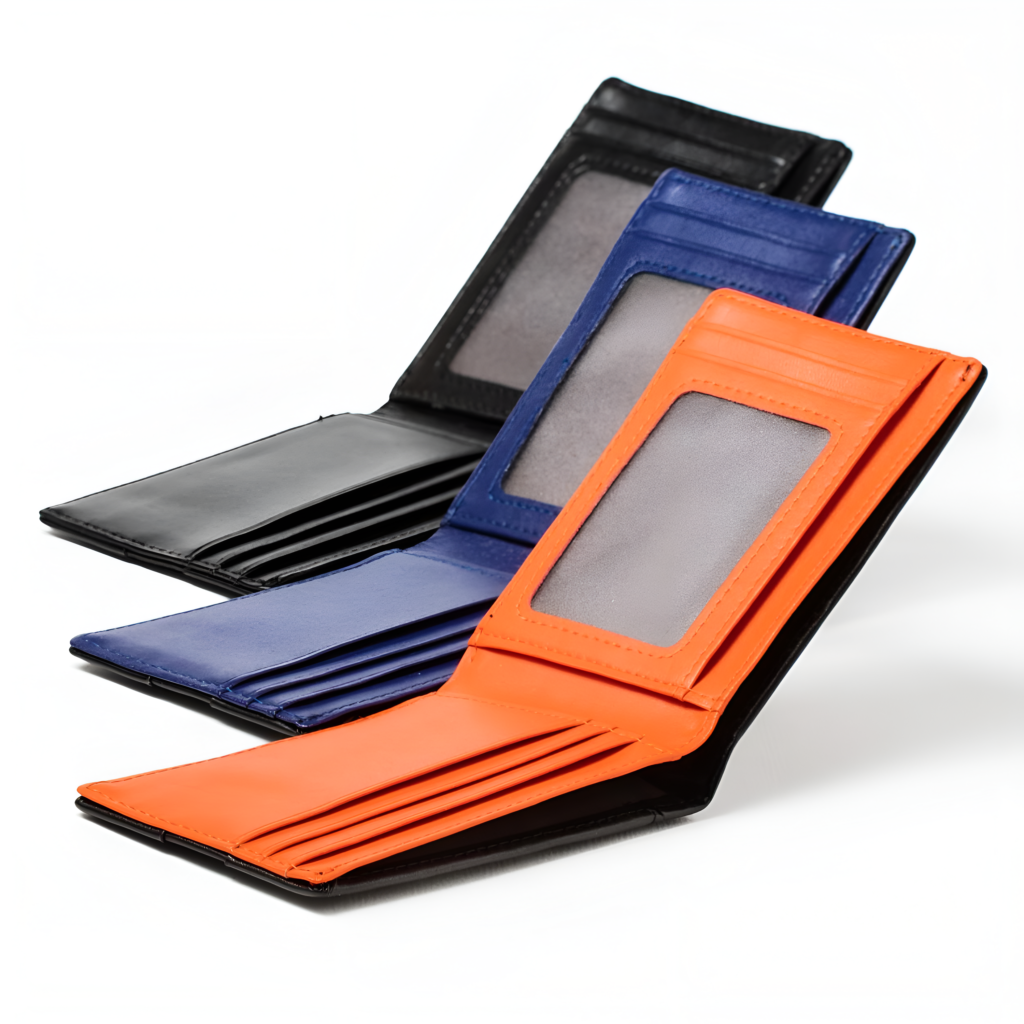
- Lined card slots
- Thoughtful material pairing
Overly thin leather without reinforcement may feel nice initially, but it fails quickly.
Step Nine: Card Slot Behaviour
Card slots are stress points.
Test them:
- Cards should slide in smoothly
- Slots should hold cards securely
- Leather should not stretch excessively
Poor-quality leather stretches permanently, leading to loose cards.
Step Ten: Weight and Density
Heavier does not always mean better, but extremely lightweight wallets often indicate thin or weak leather.
Quality leather feels:
- Dense without being stiff
- Substantial without being bulky
Density reflects fibre integrity.
Step Eleven: How the Wallet Responds to Light Use
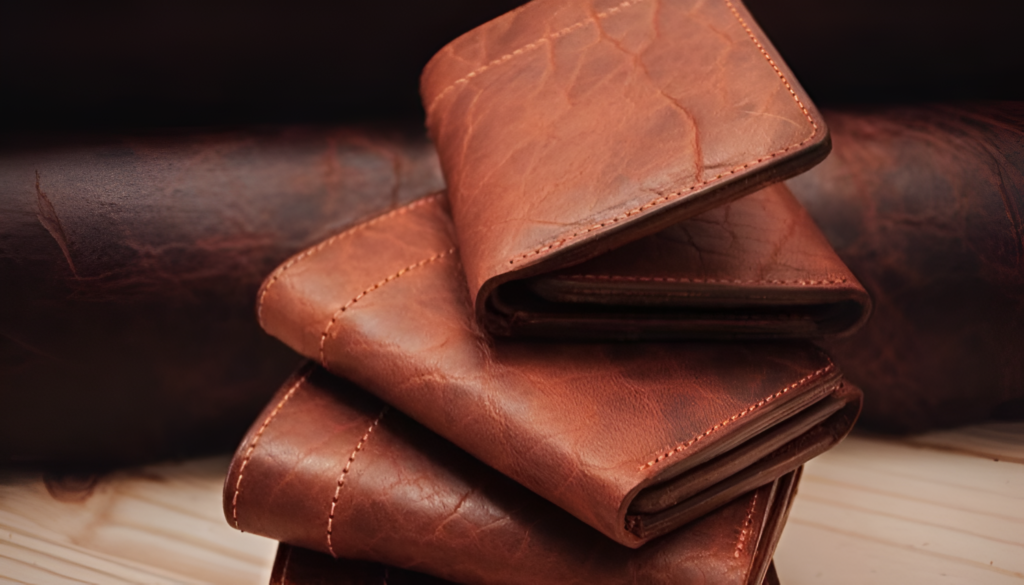
One of the most reliable indicators of a high-quality leather wallet is not how it looks when brand new, but how it responds to light and early use. This stage often reveals more about leather quality than any label, description, or initial impression.
Light use refers to the first few days or weeks of normal handling, opening and closing the wallet, inserting and removing cards, carrying it in a pocket, and holding it in the hand. During this period, good leather begins to reveal its true behaviour.
Early Flexing and Fold Response
When a wallet is lightly used, the fold line is the first area to experience stress. High-quality leather responds to this stress gradually. It bends smoothly without producing sharp creases, cracking sounds, or stiffness. The fold may become slightly more relaxed, but it should not feel weak or unstable.
Poor-quality leather often reacts differently. Early flexing can cause visible creasing, surface cracking, or resistance that feels brittle. If a wallet fights against movement or shows damage after minimal use, it is unlikely to age well over time.
Surface Reaction to Handling
High-quality leather responds positively to touch. After light use, the surface may feel slightly smoother or warmer, especially in areas handled frequently. This is a sign that the leather fibres are interacting with natural oils from the skin and redistributing internal oils naturally.
Lower-quality leather, particularly leather with heavy surface coatings, often shows no positive change at all. The surface may feel unchanged, plasticky, or even begin to scuff or dull unevenly. In some cases, the finish may start to wear away rather than blend into the surface.
Behaviour Around Card Slots and Edges
Card slots are another key stress point during early use. In a high-quality leather wallet, slots loosen gradually and evenly, maintaining their shape while becoming easier to use. The leather stretches minimally and recovers well.
In lower-quality wallets, card slots may either stretch too quickly, becoming loose within days, or remain rigid and resist use. Rapid stretching indicates weak fibre structure, while excessive stiffness often leads to cracking later on.
Edges also reveal quality early. High-quality leather edges remain clean and stable after light use, even if they soften slightly. Poor-quality edges may begin to fray, peel, or separate, particularly if synthetic edge paint is used.
Subtle Visual Change vs Early Damage
Light use should result in a subtle visual change, not damage. Slight tonal variation, softening of grain, or minor surface marks that blend naturally are positive signs. These indicate leather that is designed to interact with use.
Warning signs include:
- Cracks forming at folds
- Coatings peeling or flaking
- Sharp creases appear immediately
- Discolouration that looks patchy or artificial
These are indicators that the leather is wearing out, not ageing.
Why This Step Matters Long-Term
How a wallet responds to light use is a preview of its future. Leather that handles early stress gracefully is far more likely to age well over years of daily carry. Leather that struggles early rarely improves with time; problems usually accelerate.
This step is important because it bypasses marketing language entirely. You are observing real behaviour, not claims. High-quality leather reveals itself through resilience, adaptability, and subtle improvement under light use, while lower-quality leather reveals its limitations quickly.
In short, a good leather wallet should feel more comfortable and cohesive after light use, not compromised.
Common Misleading Signals of Quality
When evaluating a leather wallet, it’s easy to mistake certain surface-level cues for indicators of high quality. Many wallets are deliberately designed to look premium at first glance, even when the underlying leather or construction does not support long-term durability. Understanding these misleading signals helps separate genuine craftsmanship from superficial appeal.
One of the most common misconceptions is that a perfectly smooth, uniform surface signals quality. In reality, overly consistent grain often indicates corrected or heavily finished leather. Natural leather, especially higher-grade leather, typically shows subtle variation in grain, pores, and texture. These inconsistencies are not flaws; they are evidence of an intact grain layer. When a wallet looks unnaturally flawless, it often means the surface has been sanded and coated to hide imperfections, which limits ageing potential.
Another misleading signal is softness out of the box. While flexibility is desirable, extreme softness can sometimes indicate thinner leather, excessive finishing, or weak fibre structure. High-quality leather may feel firm initially and soften gradually with use. Immediate softness is not inherently bad, but it should be evaluated alongside thickness, resilience, and recovery when the leather is bent or pressed.
Strong leather scent is also frequently misunderstood. A rich smell is often associated with “real leather,” but scent alone says little about quality. Some lower-grade leathers are chemically treated to enhance smell, while some high-quality leathers have a mild or neutral scent depending on tanning and finishing methods. Smell should never be used as a primary quality indicator.
Weight and thickness can also be deceptive. A heavier or thicker wallet is not automatically better. Excess thickness may compensate for weaker leather or poor construction, resulting in bulk without durability. High-quality leather can be relatively thin while remaining strong due to a dense fibre structure.
Branding and price are another common trap. Logos, embossing, and high price points can create an impression of quality without guaranteeing it. A high-quality leather wallet is defined by material integrity, stitching precision, and thoughtful construction, not branding prominence.
Finally, marketing terms such as “premium leather,” “crafted leather,” or even “100% genuine leather” are often misunderstood. These phrases are not regulated quality standards. In particular, “genuine leather” is a broad category that can include lower layers of the hide with limited ageing potential. Without context about grain type, tanning, and finishing, these terms provide little meaningful information.
Recognising these misleading signals helps shift focus away from appearance-driven assumptions and toward the factors that actually determine whether a leather wallet will hold up, age well, and remain comfortable over years of daily use.
How to Tell if a Leather Wallet Will Age Well
A wallet likely to age well:
- Is it full-grain or lightly finished
- Shows natural grain variation
- Bends smoothly
- Has strong stitching and edges
- Feels better with handling, not worse
If a wallet already feels fragile, ageing will not improve it.
Conclusion
Learning how to tell if a leather wallet is good quality is less about memorising labels and more about understanding behaviour. High-quality leather reveals itself through flexibility, recovery, grain integrity, and construction, not perfection or polish.
A truly high-quality leather wallet is one that responds well to daily life. It bends without breaking, ages without failing, and becomes more comfortable with time. Once you know what to look for, quality becomes easier to recognise and much harder to fake.